Augsburg and the Fuggerei
Bavaria’s oldest city, forty minutes out — Roman roots, Renaissance gold, and the Fuggerei’s five-century experiment in decency.
The short version
- Trains run Munich–Augsburg every few minutes at peak, 30–45 minutes depending on service — regionals take the Bayern-Ticket; times at bahn.de.
- The Fuggerei is the reason to come: the world’s oldest social housing, founded by Jakob Fugger in 1521, where around 150 residents still pay the original annual rent — a Rhenish guilder, about 88 cents — plus three daily prayers for the founder’s soul. Details at fugger.de.
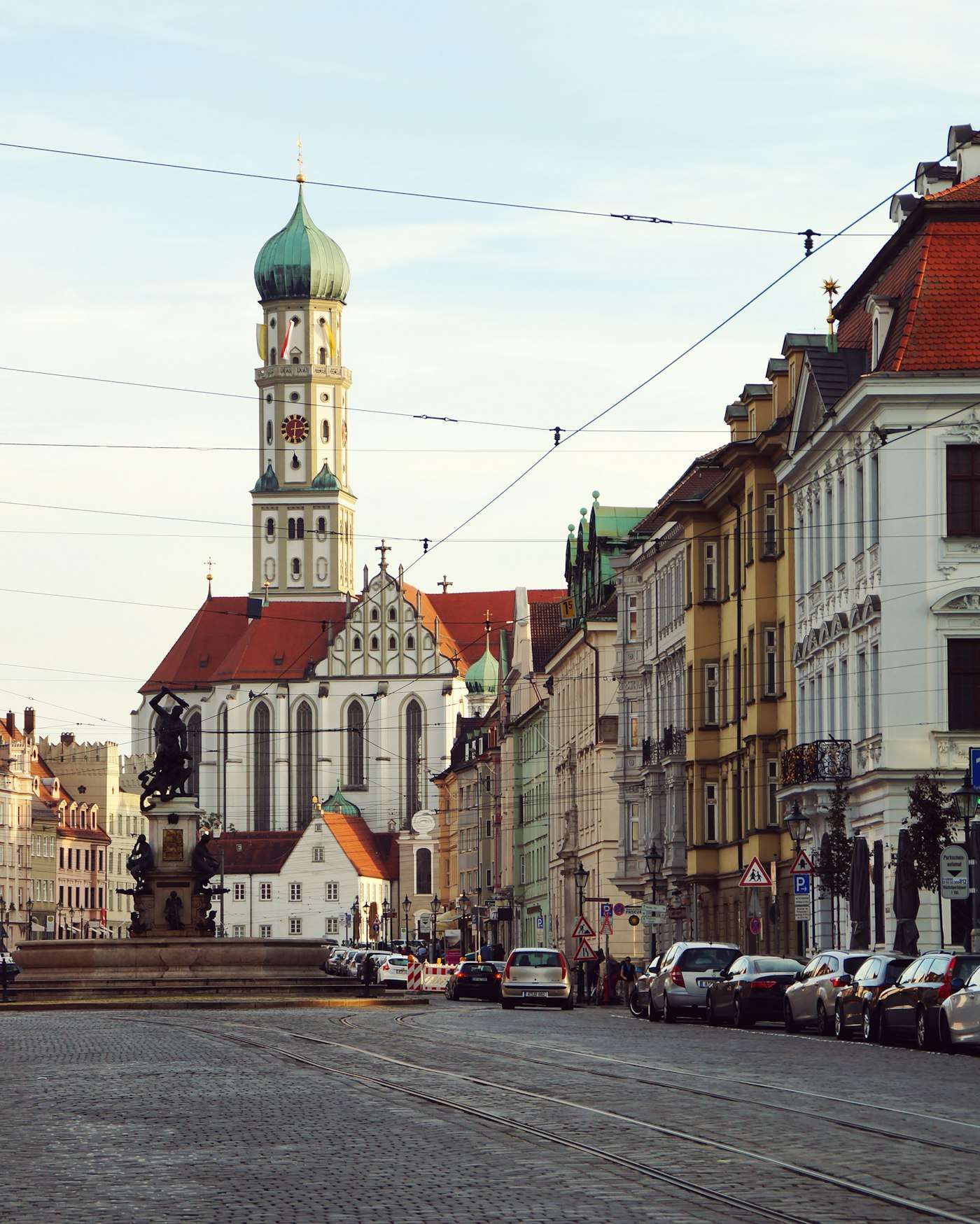
- Maximilianstraße runs the length of the Renaissance city between bronze fountains, from the Rathaus — whose Golden Hall lives up to the name — to the twin churches of St. Ulrich.
- Augsburg’s canals, water towers, and fountains took a UNESCO listing in 2019: the city managed drinking and power water separately for six centuries, and the machinery survives.
- Bertolt Brecht was born here (his house is a small museum), Mozart’s father Leopold too, and the Augsburger Puppenkiste marionette theatre is a German household name with its own museum.

Getting there
Trains leave München Hauptbahnhof for Augsburg constantly — high-speed services do it in about half an hour, regionals in 45 minutes on the Bayern-Ticket, which pays for itself for any pair traveling together. Augsburg Hauptbahnhof stands a 15-minute walk or short tram ride from the Rathausplatz, and the whole sightseeing city fits between there, the Fuggerei, and Maximilianstraße’s southern end — flat, compact, and walkable.
The day
Start at the Rathausplatz: the Renaissance town hall’s Golden Hall — a ceilinged blaze of gilt rebuilt after 1944 — and the Perlachturm beside it set the city’s scale. Walk east into the Fuggerei and take it slowly: gabled lanes, window boxes, the museum apartment showing life in 1521 and another showing it now, and the church where the residents’ end of the bargain — three prayers a day for the Fugger family — is still kept. Jakob Fugger was plausibly the richest private man in history; this is what he built to answer for it. Lunch in the Altstadt’s canal quarter, where the UNESCO-listed waterways thread under bridges and past the old butchers’ hall, then take Maximilianstraße south past the Herkulesbrunnen to St. Ulrich’s onion-domed basilica. Brecht’s birthplace, the Mozarthaus, or the Puppenkiste museum fill the last hour by taste — playwright, prodigy’s father, or marionettes; Augsburg contains multitudes for a city Munich treats as a suburb.
When to go
Year-round. The Fuggerei and Golden Hall are indoor anchors, and the city stays calm even in high summer when Munich heaves. December adds a Christmas market on Rathausplatz with the Golden Hall glowing above it; late August brings the Friedensfest, Augsburg’s own public holiday — unique in Germany — celebrating religious peace since 1650.
Frequently Asked Questions
How do you get from Munich to Augsburg?
Trains run every few minutes: about 30 minutes on fast services, 45 on regionals covered by the Bayern-Ticket. The old town is a 15-minute walk or quick tram from Augsburg Hauptbahnhof.
What is the Fuggerei rent, really?
The nominal cold rent is 0.88 euros per year — unchanged since 1521 — plus utility costs and a commitment to three daily prayers for the founders. Residents must be Augsburg citizens, Catholic, and in need through no fault of their own. Around 150 people live there today.
Why is Augsburg a UNESCO site?
For its water management: from the 15th century the city ran separate systems for drinking water and power, with canals, water towers, and hydraulic engineering that influenced Europe. Twenty-two sites across town carry the 2019 listing.
Is the Golden Hall worth the entry?
Yes — the Rathaus’s ceremonial hall is one of Germany’s great Renaissance rooms, destroyed in 1944 and rebuilt over decades to full gilded glory. Entry costs a few euros and the visit takes half an hour.
What is the Puppenkiste?
The Augsburger Puppenkiste, a marionette theatre broadcasting since the 1950s, is a German childhood institution. Its museum by the city wall shows the original puppets — nostalgia for locals, charm for everyone else.