Regensburg on the Danube
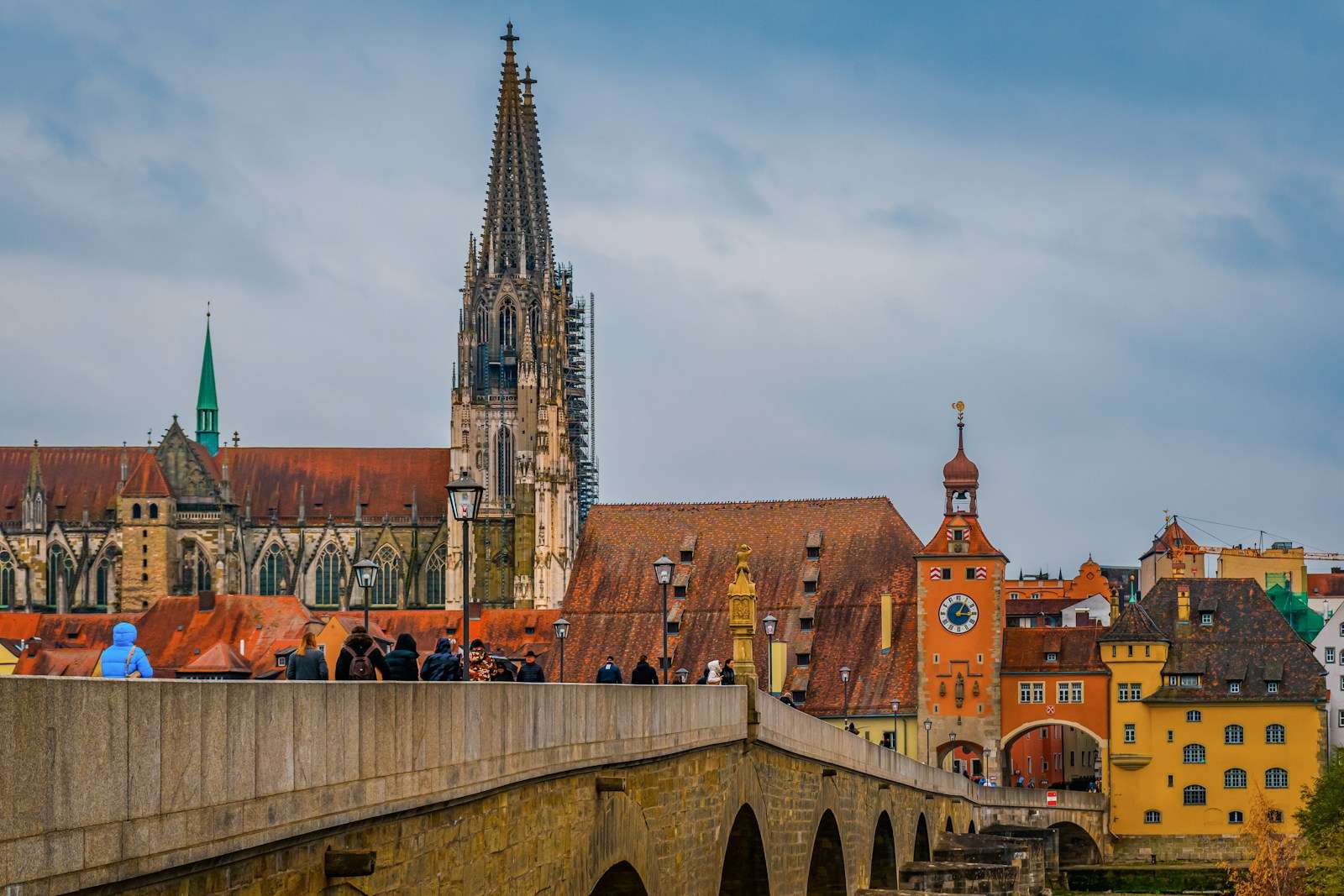
An hour and a half north on the Bayern-Ticket, the war largely passed Regensburg by — what you walk is Germany’s best-preserved medieval city, crossed by a 12th-century bridge with a sausage kitchen at its foot.
The short version
- Regional trains run Munich to Regensburg in about ninety minutes, covered by the Bayern-Ticket’s flat day fare — bahn.de — the same regional-ticket arithmetic this network’s Salzburg page runs.
- The old town’s UNESCO listing rests on survival: Germany’s best-preserved medieval city, largely untouched by the war’s bombing, with patrician tower-houses, Romanesque chapels, and the street plan of the Holy Roman Empire’s parliament town intact.
- The Stone Bridge — built 1135–1146 — crossed the Danube for eight centuries as the region’s only fixed crossing and served as the model for medieval bridges across Europe; it walks free, pedestrian, and best at both ends of the light.
- The Wurstkuchl at the bridge’s foot claims the title of the world’s oldest continuously operating public eatery — a claim the kitchen has been backing with charcoal-grilled sausages, sweet mustard, and sauerkraut from the same riverside spot for centuries; the queue moves fast and the plates settle the argument.
- The Dom St. Peter is Bavaria’s great Gothic cathedral, home of the Domspatzen — the cathedral sparrows, a boys’ choir over a thousand years old by institutional descent — singing the Sunday morning mass per the alarm’s early-arrival clause.
- The supporting bench runs deep: the Thurn und Taxis palace (the postal dynasty’s seat, tours ticketed), the Document Reichstag tour in the Old Town Hall (the Perpetual Diet sat here 1663–1806), and Walhalla — the Parthenon-on-the-Danube memorial hall — reachable by boat or bus as the classic add.

Getting there
The Bayern-Ticket makes the trip a flat-fare shrug — regional trains at steady frequency, no reservations, and the same ticket covering city transit at both ends. The station sits ten minutes’ walk from the old town’s edge. Danube boats run seasonal schedules to Walhalla for the add-on hour; everything else is feet. The town’s compactness is its gift: no transit day, no logistics, just lanes.
The day
Cross the Stone Bridge first for the classic view back — the cathedral’s spires over the medieval roofline, the Danube doing its part — then take the Wurstkuchl’s plate per the alarm while the queue is short: six sausages, kraut, sweet mustard, riverside standing. The old town absorbs the middle hours: the Dom’s stained glass and the Domspatzen if your day is a Sunday, the patrician towers of the Italian-styled merchant quarter, the Old Town Hall’s Reichstag rooms where the Empire talked itself through a century and a half, and the Thurn und Taxis palace for the ticketed hour. Coffee culture runs strong (the town claims some of Germany’s oldest cafés); the Danube terraces pour the evening version. Walhalla’s marble hall — King Ludwig’s pantheon of German greats on its hill downstream — takes the boat-or-bus afternoon for the committed. The regional train home asks nothing of you but a platform number.
When to go
The town runs year-round on stone and interiors — May through September adds the Danube terraces, the boat schedules, and festival evenings; December dresses the lanes for the Christmas markets, including the Thurn und Taxis palace market at full romantic throttle. The Domspatzen’s Sunday mass holds through the school year with breaks around holidays — the alarm’s early clause matters because the nave fills. Summer Saturdays bring day-trip crowds to the bridge and kitchen; the town swallows them by mid-afternoon.
Frequently Asked Questions
Is the oldest-restaurant claim true?
It’s a long claim with real centuries behind it — documented cooking on the site back toward the bridge’s construction era, continuous operation argued in its favor, and rival claimants elsewhere argued politely against. The town states it as its own tradition holds, which is how this page states it. The sausages are not contested.
What’s the Document Reichstag about?
The Old Town Hall hosted the Perpetual Diet — the Holy Roman Empire’s standing parliament — from 1663 to 1806, and the guided tour walks the actual chambers, benches, and the dungeon below. It’s the rare place the Empire’s machinery is physically walkable, and the tour keeps it vivid rather than dusty.
Is Walhalla worth the extension?
As a spectacle, yes — a full Doric temple on a Danube bluff, filled with marble busts of German-speaking greats, reached by a grand stair the river view justifies. The seasonal boat makes it a lazy round trip; the bus is the pragmatic version. It costs the town two to three hours, which the town can spare.
What exactly is the Bayern-Ticket trick?
A flat day fare covering regional trains and local transit across Bavaria for up to five people — the per-person price collapses as the group grows, and it turns day trips like this one (and this network’s Salzburg run) into pocket-change logistics. It excludes fast trains; the regional timetable is the honest schedule.
Regensburg or Nuremberg from Munich?
Both run the regional-ticket arithmetic; Regensburg for intact-medieval texture and the bridge-and-kitchen ritual, Nuremberg for bigger history at heavier registers. Preservation versus reconstruction is the honest axis — Regensburg is the one the war forgot, and it reads that way in every lane.